Relating Remotely
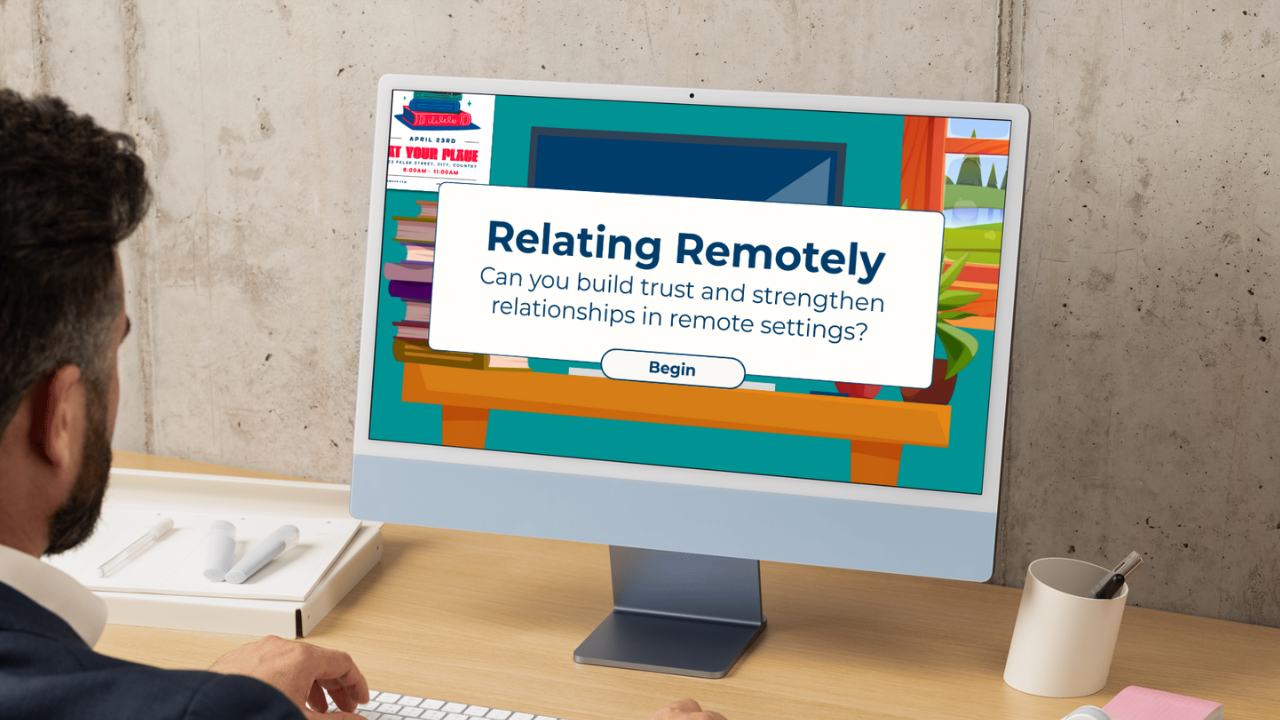
I designed this scenario-based eLearning concept project for new hires at a distance education company to strengthen client relationships in remote settings.
Overview
The Problem: Smart Sparks Academy (a fictitious client for this conceptual project) has reported that their remote contractors often struggle to retain clients after the first few months due to unclear or ineffective communication strategies.
This issue led to costly consequences, including loss of business to competitors, dissatisfied clients, and high turnover rates as contractors became frustrated by the lost hours and income when their client engagements dwindled.
The Solution: After analyzing the performance problem, I confirmed that the contractors lacked clear expectations and models for communicating in remote environments. I proposed a scenario-based eLearning experience where the contractors could practice communicating with parents at different stages of their engagement with the family and in response to common issues.
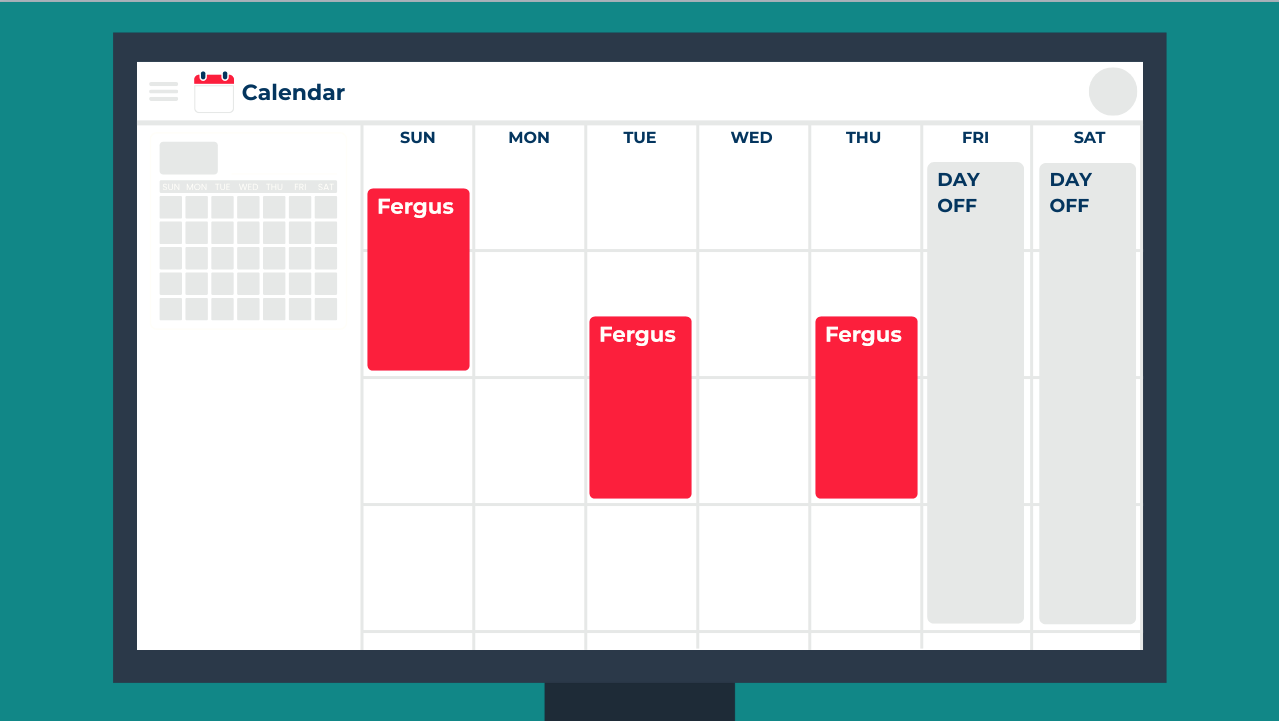
The goal was to improve client retention and reduce the financial impacts of the problem by providing new hires with a risk-free environment to make choices and see the real-world consequences of their actions. I also proposed a gamified “schedule dashboard” to motivate the learner with rewards for good communication that parallel the real-life outcomes of maintaining strong client relationships.
AUDIENCE
TOOLS
SKILLS
Process
I followed the ADDIE model (Analyze, Design, Develop, Implement and Evaluate) to create this interactive learning experience. I connected outcomes to actions in the analysis phase, built a text-based storyboard in the design phase, and mocked up both static and interactive visual prototypes in the development process. I focused on meeting the learner’s need by delineating clear choices and outcomes to reinforce practical behaviors, and by adding realism and depth to the scenarios to increase emotional engagement.
Action Mapping
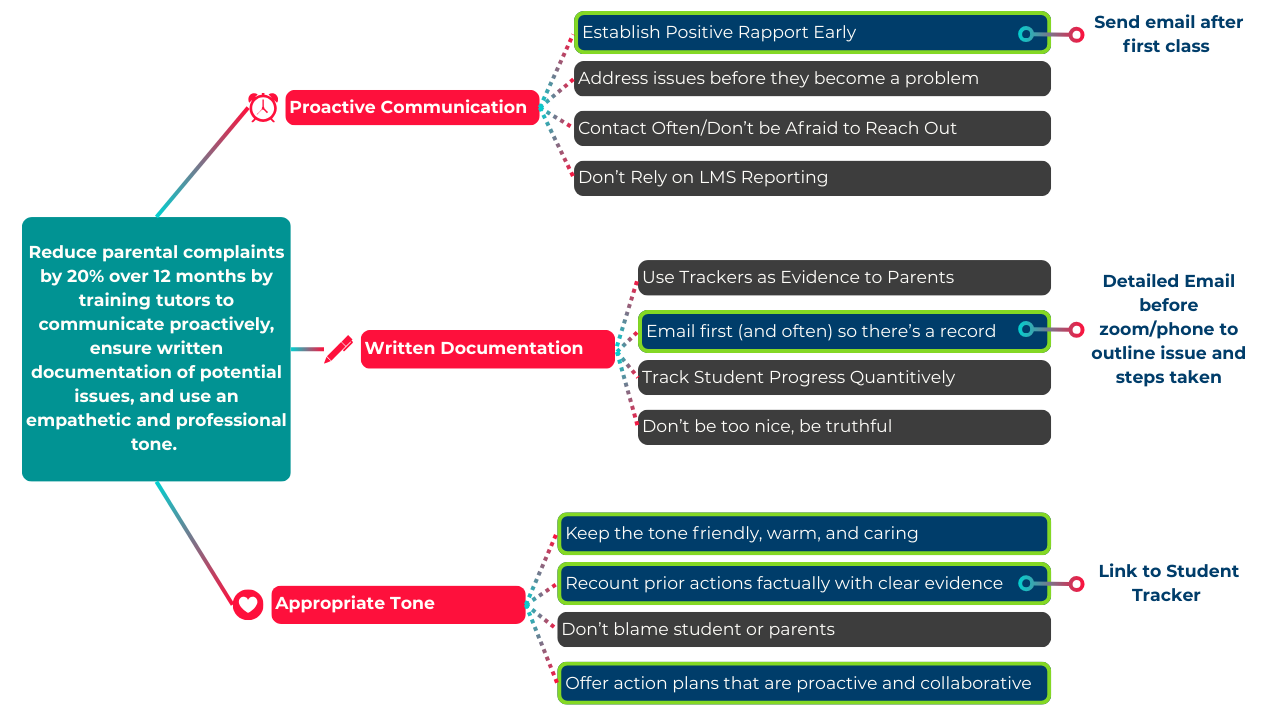
I consulted the CEO of a distance education company as my subject matter expert (SME) to develop an action map and establish the goals for the project. We decided to measure progress by monitoring the client complaint and retention rates. We then identified actions that the contractor can take to build trust and reduce customer complaints.
Text-Based Storyboard
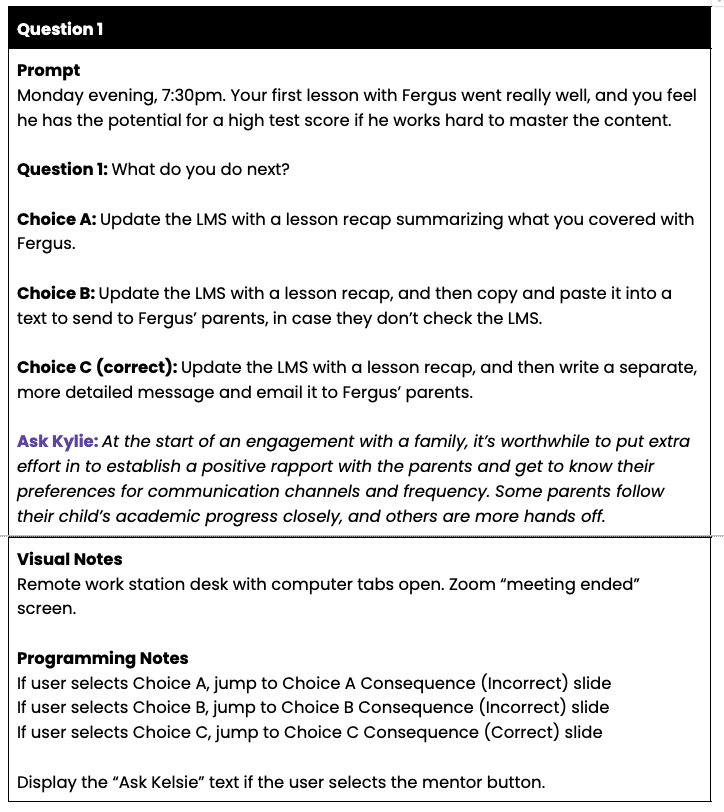
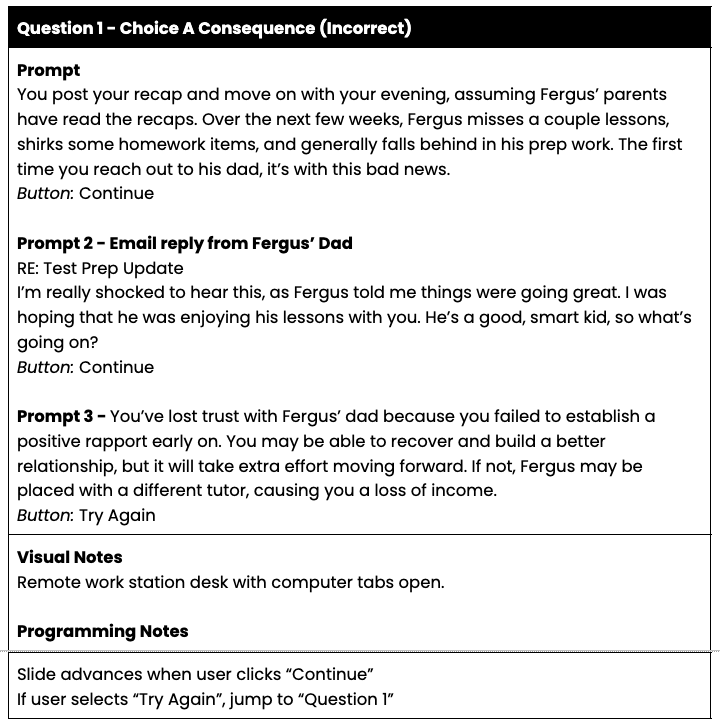
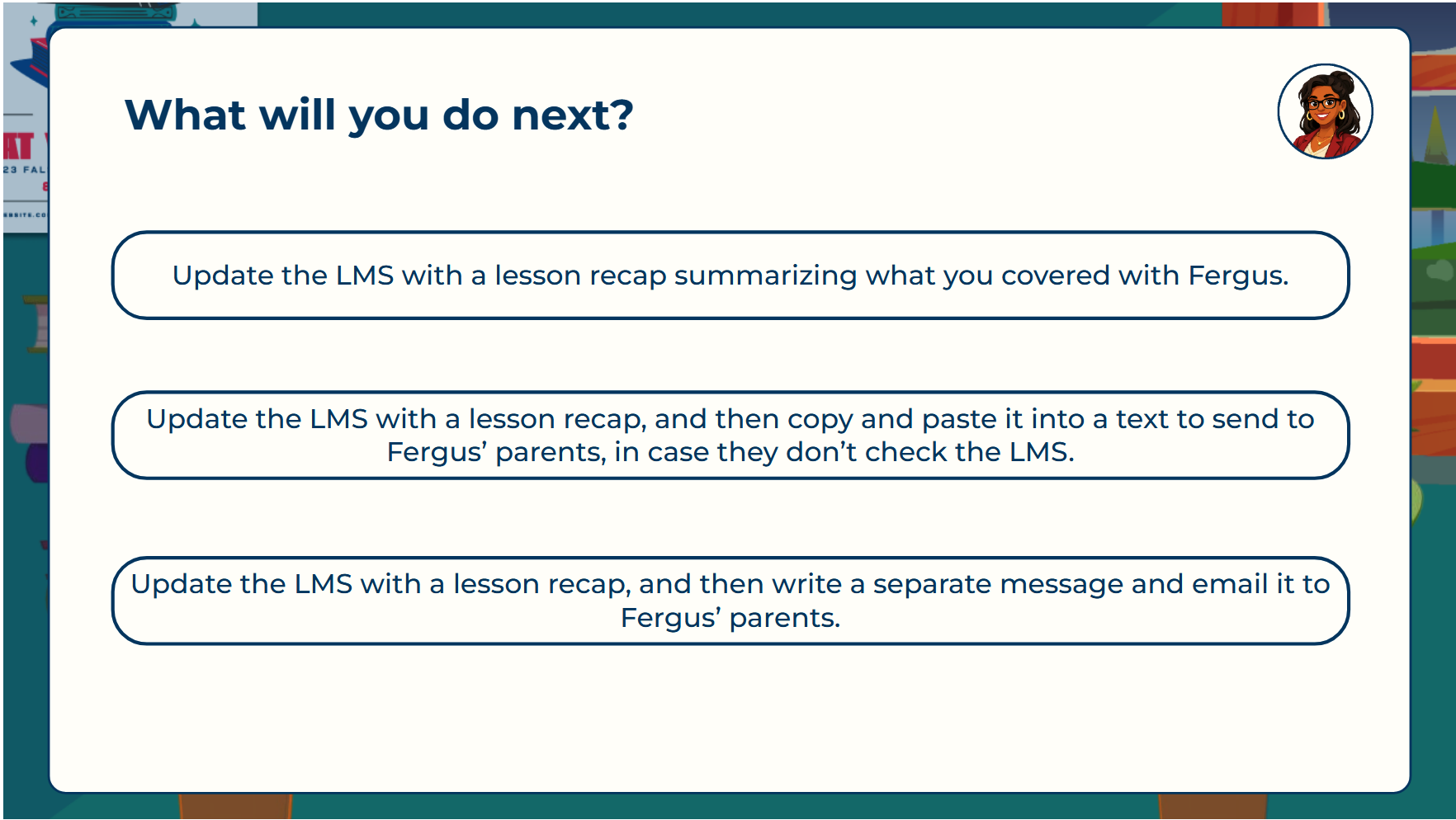
Once the action map was completed and approved, I wrote a text-based storyboard to turn the key actions into a cohesive narrative with realistic, branching scenarios and consequences. The scenarios gave the learner risk-free opportunities to learn from common mistakes. While there were many real-life examples to choose from, I chose to focus on scenarios that take place in the most critical period of the client’s journey with the company — the initial lesson and the first couple months of an engagement — in which trust is first established.
Selecting an incorrect choice would require the learner to either try again immediately or lead them through an extended sequence of events that shows real-world consequences and provides feedback. The storyboard included programming notes on how the slides would branch based on user choices.
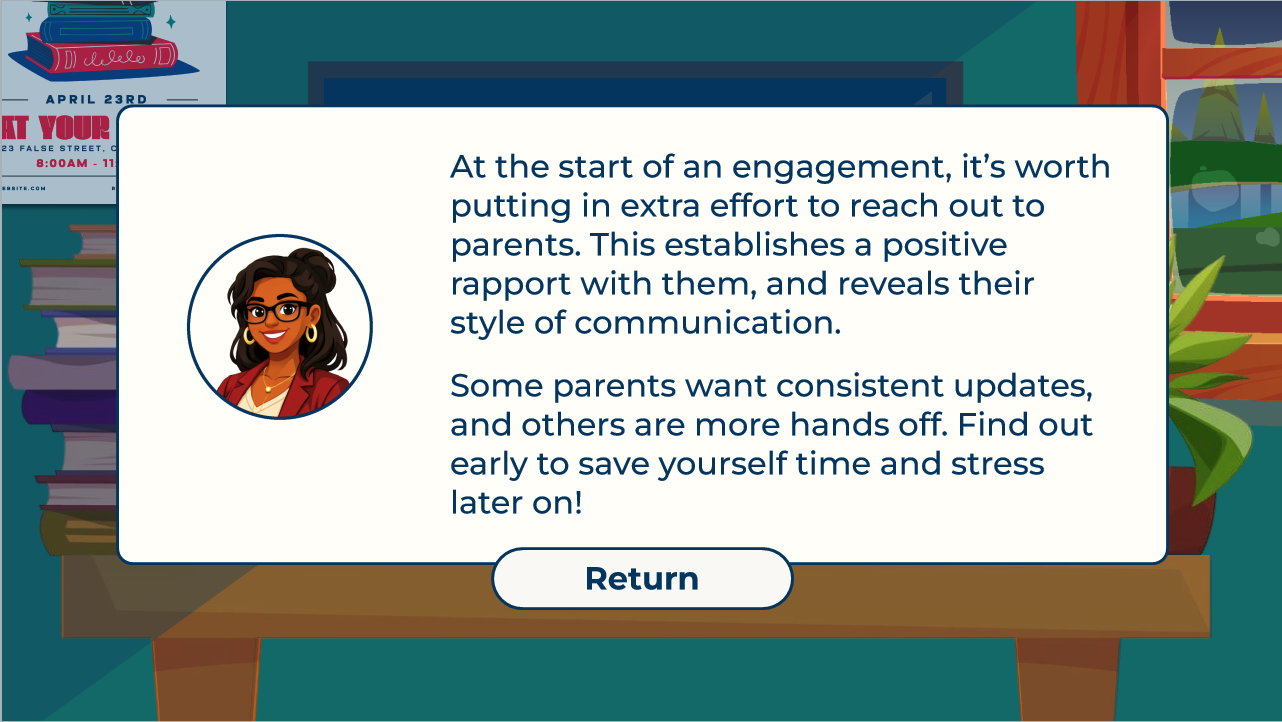
In addition, I introduced a mentor “tutor trainer” character who provided optional tips at the learner’s request without interrupting the narrative. Her role as ‘mentor’ paralleled the real-world experience of the learner, as new hires are paired with a trainer to help them navigate their first engagements. The learner is initiated into the daily interactions and operations of the company, adding to the realism of the training.
Visual Mockups
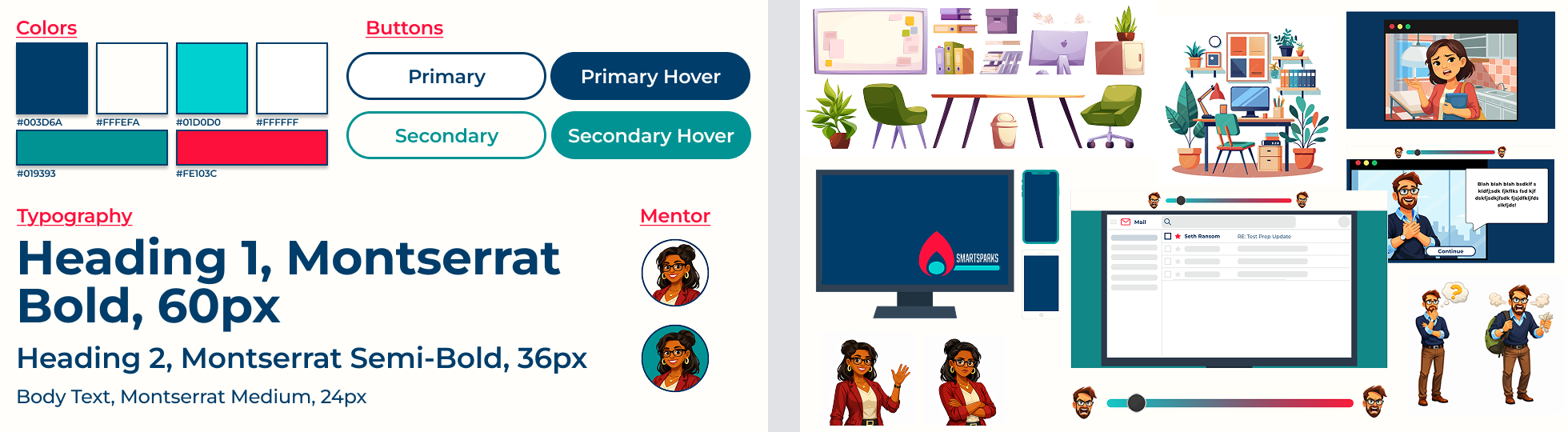
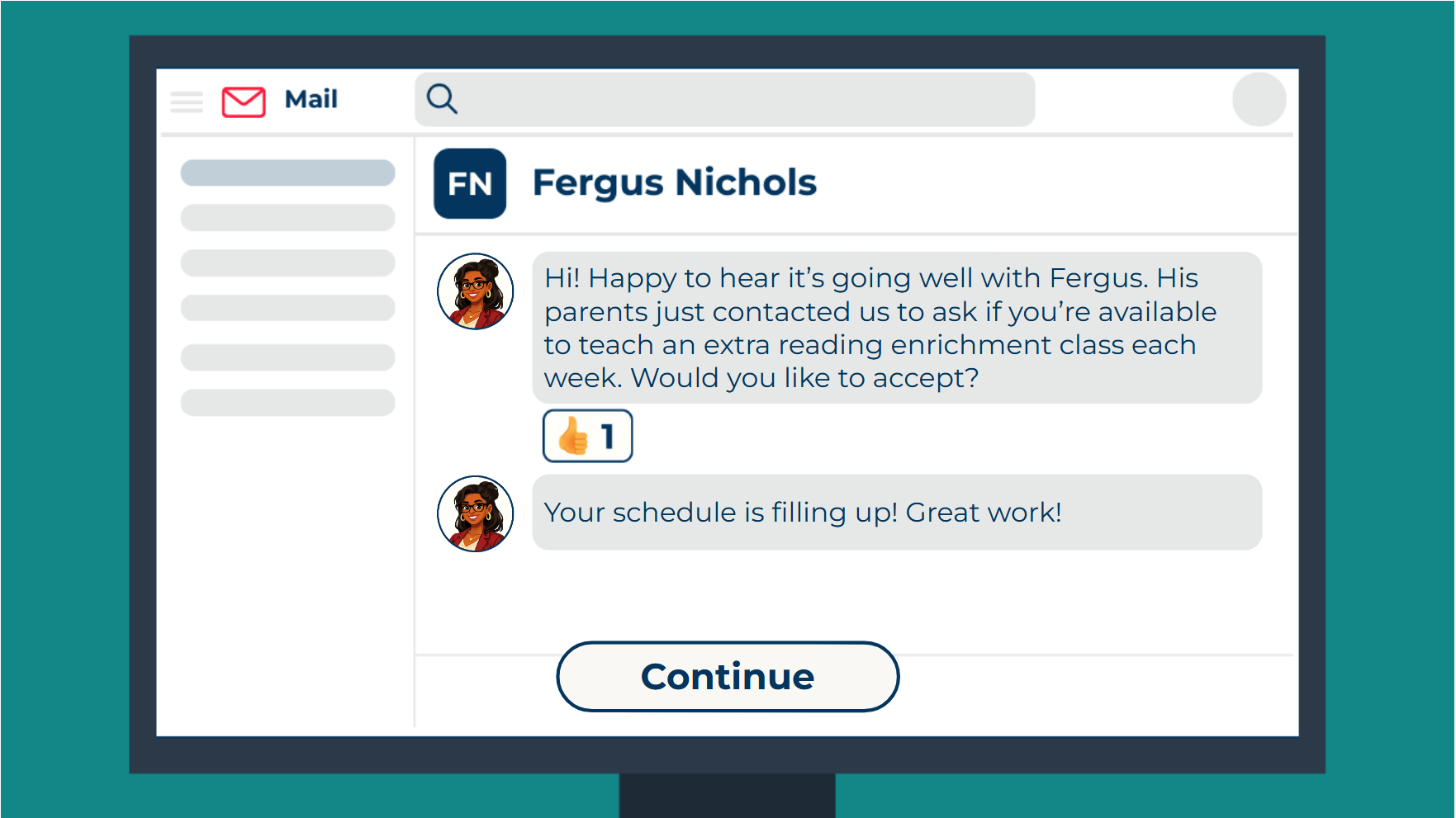
To create a consistent design, I used Figma to design a mood board, style guide and wireframes. These images helped establish the colors and feel of the experience, and establish the flow of the daily operations of remote communication, including opening emails and answering phone calls. Planning the flow of interactions helped ground the logic of the narrative, and reinforced desired behaviors through repetition.
The mockups also improved the user experience of the design and minimize the complexity of the visuals to their essentials. I designed the buttons, prompt boxes, font, and speech bubbles with the goal of encouraging communication choices and emotional engagement, which led to calm, crisp colors and different font weights for the various channels (email, text, and phone call dialogue texts).

Interactive Prototype
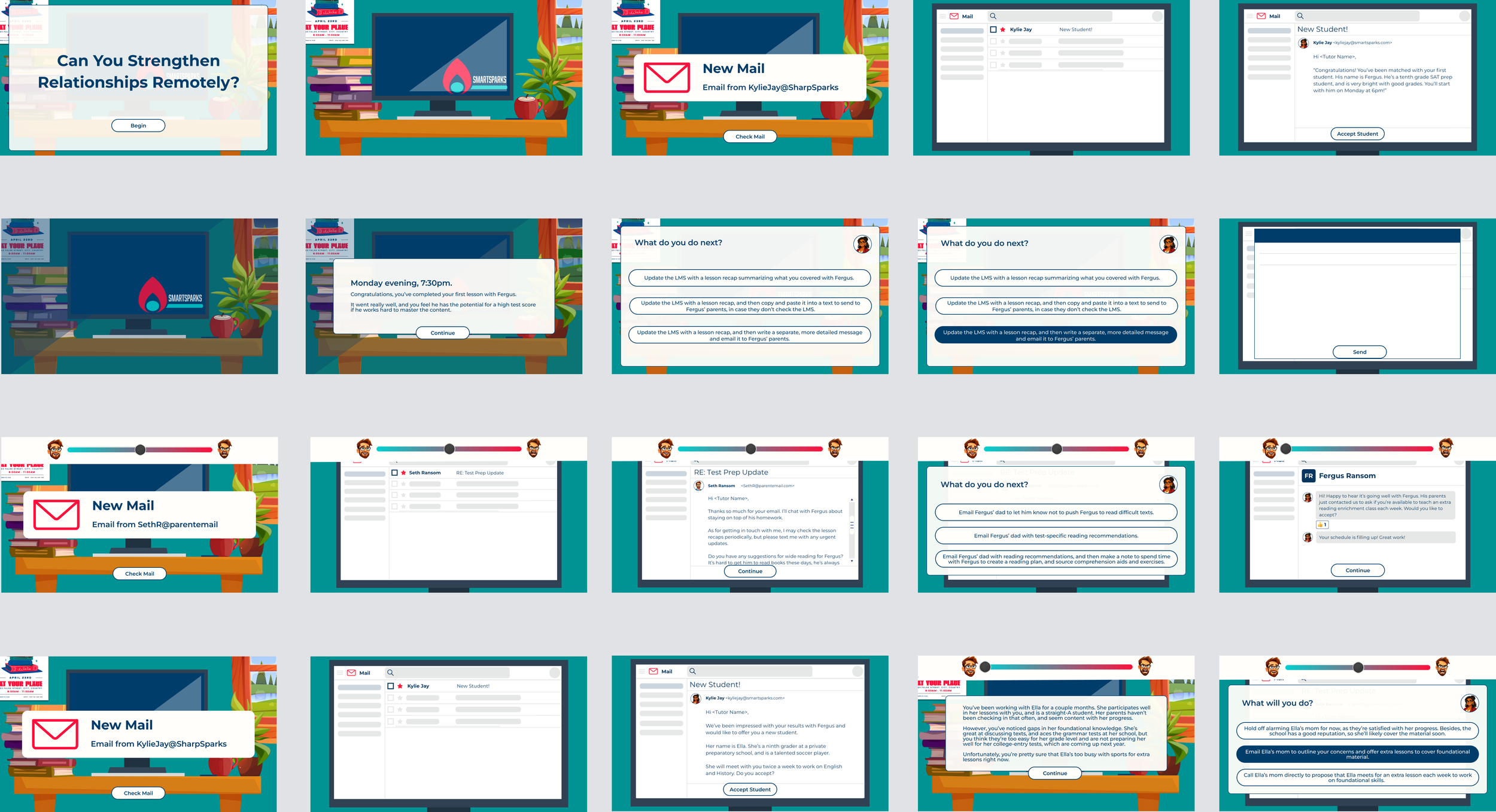
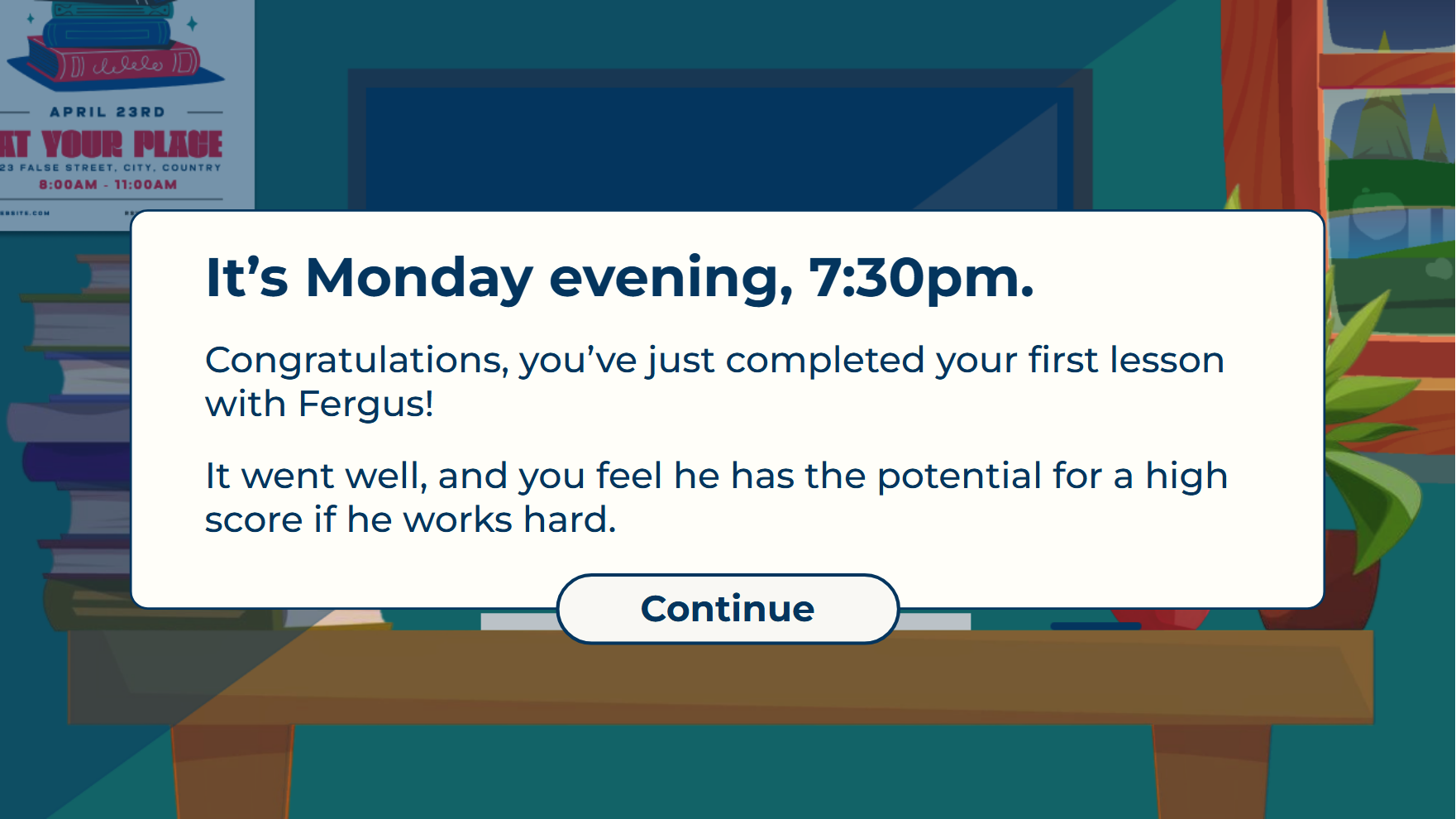
Next, I created an interactive prototype in Articulate Storyline 360 to replicate the flow and function of the eLearning experience. The prototype included the title, mentor character introduction, and establishing narrative slides, as well as the first scenario and set of consequences. I programmed consistent intro and exit animations for the different prompt and dialogue boxes to increase the sense of flow in the narrative. I also programmed a live email deployment slide using Javascript to enhance the immersive and realistic elements of the design.
Based on the feedback, I made adjustments, refining the transitions and interactions, and removing an interactive anger-level slider to keep the design focused. I moved on to the full development once I was satisfied with the changes.
Full Development
The full development of the remaining scenarios was straightforward after the elements had been created and the transitions and programming framework had been refined.
Results & Takeaways
I shared this project with my professional network and the reception was overwhelmingly positive. Viewers commented on the enjoyable user experience, immersive quality, emotional engagement, and clear takeaways. The CEO was impressed with the result and thought it would be a valuable resource for new tutors.
As this was a conceptual project, the next step would be to conduct user testing and gather data and feedback from remote professionals on the impact of implementing these strategies with clients. There are a few directions I’d like to take this project in with more time and resources:
Increased Interactivity and Real-Time Feedback: Consistently, people commented on the ‘live’ element of the animations and consequences that unfold following each choice. I would enhance this interactive element by leveraging AI and Javascript to create parent and mentor chatbots that offer in-the-moment reactions and responsive and summative coaching to help navigate live calls with parents, or text conversations.
Expanded Narrative Pathways and Scenarios: This experience focuses on the pivotal first few months of an engagement with three short scenarios. A fully expanded sequence could include multiple scenarios along one client’s journey through a 6, 12 or 24-month engagement, or present multiple student archetypes to cover a larger range of interactions. This would increase each educators range and prepare them for long-term engagements.